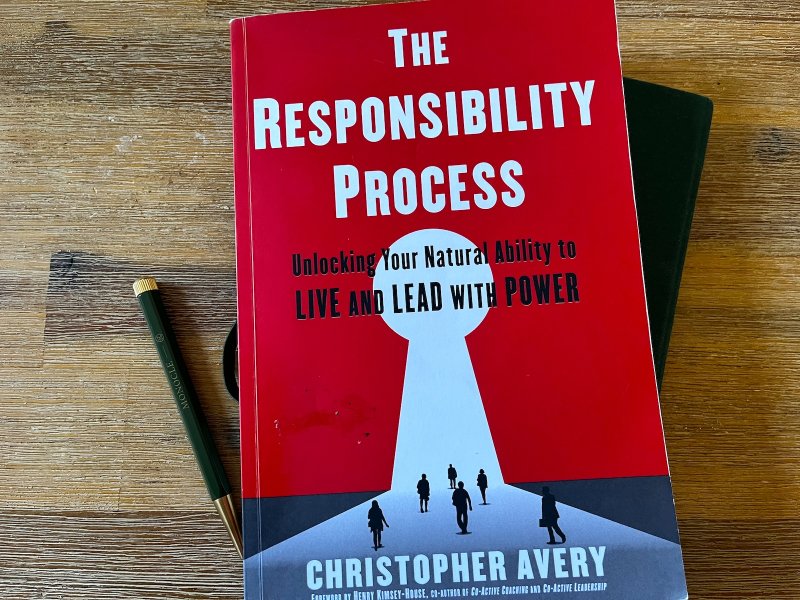
Avery, Christopher (2016): The Responsibility Process. Unlocking your natural ability to live and lead with power. Pflugerville, TX: Partnerwerks, Inc.
Abstract
Avery's The Responsibility Process places an important — if not decisive — principle between self-leadership and accompanying teams: responsibility. With its many reflective questions and exercises, it also successfully balances daily challenges with a very deliberate approach to dealing with them.
Avery provides a plausible and, more importantly, usable understanding of a pattern that is observable in both personal and professional everyday situations. By naming the stages and the associated behaviours, Avery has provided a helpful tool for analysis and self-awareness that can be used to situate oneself in light of the situation. Not everything in The Responsibility Process is completely new, but it has been vividly brought to the point.
The stages
When something goes wrong, we tend to cycle through predictable mental states before reaching genuine responsibility:
- Lay Blame — attributing problems to others
- Justify — attributing problems to circumstances
- Shame — self-blame without constructive action
- Obligation — acting from external pressure rather than choice
- Responsibility — conscious, empowered action
The three keys
The three keys guiding the process are intention, awareness, and confrontation — a set of practices for deliberately moving towards responsibility rather than staying trapped in earlier stages.
Assessment
The author of this review, who has taken workshops with Avery in addition to reading the book, remains convinced of the concept. Going into every situation — no matter how difficult — with clear intention, continuously locating oneself within the process, and effectively navigating work and life in "freedom, power and choice" remains one of the most helpful tools in both coaching and product leadership.
Written September 2021 for TU Kaiserslautern / Systemic Consulting.
Photo credit: M. Stahl